Dimmable LED down lights
update 5/4/2013. Just tried a 10W Philips MASTER LEDspot MR16 LV dimmable. Very impressed. Full review here. I’ll probably use these 10W Philips LEDs to replace all 10 of our kitchen halogens.
update 25/4/2013 We have replaced all 10 of our halogens with 10W Philips MASTER LEDspot dimmables. Impressed! Full review here.
But I’ll leave my old notes below just in case they’re of use…
Our kitchen is currently lit with 10 × 50 watt tungsten lamps. Yes: that’s a total of 500 watts. Which is utterly obscene and I feel distinctly uncomfortable just thinking about it (Why do we have such a power-hungry lighting setup in our kitchen? We had some work done on our bathroom last year which required the builders to replace the light fittings in the kitchen below the bathroom; I thought the builders would replace the lamps with the original 20 watt tungstens but no, in their infinite wisdom they threw away my old lamps, fittings and transformer and replaced them with 50 watt tungstens. Humph.). We want to replace these tungstens with LEDs, hence reducing the power required to light the kitchen by a factor of 10 or so. We have several requirements:
- Must be dimmable down to 5% or 1% (some only dim down to 60%)
- Must produce enough light to fill the kitchen
- Must produce a warm, cosy light
- Must produce a light with a high enough colour rendering index to mean that skin looks like skin and not like pale plastic
Dimming LEDs requires a fundamentally different approach to dimming incandescent lamps. LEDs require a constant current at all times. The best approach to dimming LEDs seems to be to switch them on and off very rapidly (100,000 times a second - far too fast for your eye to perceive a flicker).
Some manufacturers produce MR16 LEDs which do work with normal TRIAC dimmers and transformers (the sorts of dimmers and transformers used for tungsten lamps). I presume these LEDs must include some clever electronics which first “decodes” the dimming signal from the normal dimmer and then uses this signal to drive a proper LED driver. For example, the Philips Dimmable MASTER LED 4W MR16 24° from ledbulbs.co.uk for £18.99 does a reasonable job of dimming from a normal dimmer. But it’s expensive and it flickers a little and only dims down to about 30% of max output. This isn’t good enough: we want something that dims down to 5%.
The lamps I’ve tried include:
- 6W Dimmable MR16 / GU5.3 12V Warm White 120° LED Bulb Super Bright at 310Lm from eCrater.co.uk for £9.41
-
Philips Dimmable MASTER LED 4W MR16 24° from ledbulbs.co.uk for £18.99
- Lovely quality of light; genuinely looks like a tungsten light. Not a huge *quantity *of light though. Expensive! Flickers a tiny but when used with a normal dimmer. Only dims down to about 30%. Does not flicker at all when used with a normal (non dimmable) 12v transformer.
-
MR16 DIMMABLE 9W LED BULB WARM WHITE CREE CHIP SUPER BRIGHT £7.59 from xclusivesuppliesuk on ebay
- Not very impressed. Flickers when using a “normal” 12v transformer (even when used without a dimmer). I’ll try it with a proper LED driver.
-
- 370 lumens (for the warm white) / 5 watts consumption = 74 lumens / watts (which is pretty good)
- I’ve bought this non-dimmable light to see if it can be dimmed using a dimmable LED driver
- Update 24/2/2012: I’ve now received this bulb. It is indeed very bright. But it has a poor CRI. Skin looks distinctly ghostly when illuminated by this lamp. Overall it produces quite an “ery” light, even when warmed up with orange lighting gel (CTO 1/4).
LEDs I found while searching but didn’t buy:
- Dimmable 4W Low Voltage High Power LED MR16 Warm White MR16 Direct Replacement for £13.99 from energylightbulbs.co.uk
- Savervalue LED Dimmable Spotlight 6W Warm White Light Bulb MR16 12V AC/DC (3 X 2W) 50mm D for £11.99 from saverstore.com
- MR16 Dummable Spot Lights from Light Planet
Attempting to get dimming down to 5%
I think we need to bite the bullet and use a proper “dimmable LED driver”, instead of using “dimmable LEDs” in conjunction with normal TRIAC dimmers. Using “dimmable LEDs” in conjunction with a normal dimmer is pretty ugly from an engineering perspective: the dimmer was never meant to be used with LEDs and the LEDs must therefore each include electronics to handle the LED dimming (e.g.these TRIAC Dimmable LED drivers made by National Semiconductors). It’s better to use “dumb” LEDs in conjunction with an LED driver which can do dimming. (There’s a good intro to dimming LEDs here).
Some dimmers I’ve found:
- MR16 LED dimmable driver 180 watts, takes 240v input. “Will operatre between 1 and 25 (6watt) MR16s.” Not clear how it works. Comes with a dimmer. £63.95 from SLB. Dims down to about 1%.
Some other dimmable LED drivers which probably aren’t appropriate for my application:
- SLV 464002 - PHILIPS LED DRIVER, DIMMABLE 700MA, 30VA £40.37 from bigwhitelighting.com
- Farnell do loads of LED drivers (not many dimmable)
- RS do lots of dimmable LED drivers. Search the http://uk.rs-online.com/RS website for “led driver dimmable”
- MeanWell do lots of dimmable LED drivers.
- mr-resistor do some interesting LED drivers (and have a 2 show rooms in London)
- I thinkthis MeanWell dimmable LED driver 12v 60W for £55 might be the one to go for. Dims 100-10%. I presume the LEDs must be put in parallel. It runs from mains (hence doesn’t require a separate PSU) and can be controlled either using a resistor or a 1-10v input. So I just need to replace the wall switch with a vairable resistor (with mains switch) and run a control cable up to the ceiling space.
- Or maybe I should use a constant current system like this Philips 75W 0-10V (£95) orthis Philips 150W 0-10V (£100). Both dim down to 10%. I think I need to use a constant current driver with
constant current LEDs.
Variable resistors with switches are available from Maplin.
update 20th Feb 2012:
Oooh, I’ve just stumbled across some nice-sounding 230v GU10 LED light fittings. Dimmable from 3-100% from a TRIAC dimmer. 8W. 60lumen/watt for warm white. CRI >83 TC110 from SGSLIGHT. I’ve asked for a sample. I found them through alibaba.com (and there are other lamps on there which dim to 3% or less).
update 22nd Feb 2012:
Looking for high CRI lamps. It looks like most LEDs have a CRI of aroun 60-75%, which is pretty poor. The highest CRI I’ve found it the CREE LRP38-10L which has a CRI of 92% but isn’t available in a package I can use.
I found that RS sell lots of LED lamps including an 8W MR16 LED warm which lamp with a CRI of 90% (and a price of £31!).
update 24 Feb 2012:
- LED magazine buyer’s guide
- LED lighting nodes from Earth.org.uk
- AliExpress has a great search facility for lights- this is probably the best place to find LEDs for import from China. And the site often quotes a CRI figure for the lights.
- Green Building Forum topics:
update 31st Dec 2012
- our existing lights have a 75mm diameter cutout
- it would appear that building regs part L1A (for new builds) require 75% of lights to have an efficiency greater than or equal to 45 lumens per circuit watt (although I did a quick text search through L1A and L1B but couldn’t find anything for “lumens” or “lm”)
-
a little more research suggests that fitting the PSU and lamp into a GU10 / MR16 package is a bad solution and that it might be better to use a “purpose built” LED downlight. Efficiencies certainly appear to be better for purpose-built downlights than most GU10 / MR16 lamps. Some purpose built downlights:
- EcoLed ZEP1 very warm white (2700K). 500 Lumens from 7W = 71 lumen / watt (pretty good). CRI=90 (excellent). Bridgelux lamps. Requires LED driver. 84mm cutout. Apparently available from led-eco-lights.com for £25.33 but the website wouldn’t let me order and no way to contact them! Downlights Direct sell it for £44.64 incl VAT and a dimmable LED driver. I have asked if they sell it without an LED driver.
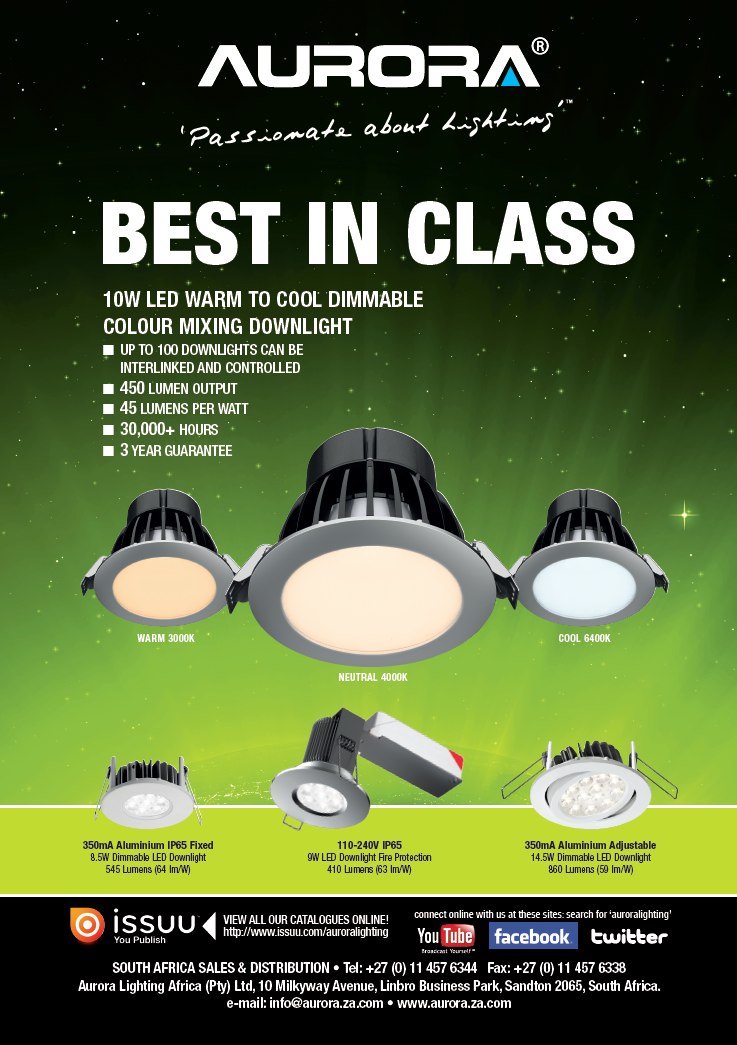
- Aurora AU-FRL9*3 9W warm white. £30 ish, 82 CRI, 420 lumen, 47 lumen / watt (not great)
- Other Aurora LED downlights. Maybe 450 lumens from 10W.
- BrightLightz 6W warm white £17 inc VAT chrome. CRI >75% 490 lumens, built-in transformer, 81 lumen/watt (very good). Worth a go. 65mm cutout though (and we have 75mm holes in our ceiling)
- Screwfix sell some 5W non-dimmable LED downlights by JCC lighting design for £25 inc VAT.
- JCC 7W dimmable (£38) or non-dimmable (£33). > 60 lm/watt (=420 lumen) meets building regs. CRI???
- Lighting Hut 6W LED ceiling light. £38 inc VAT each. 540 lumens from 6 W = 90 lumens per watt (very good). No mention of CRI.
-
I liked the Philips MR16 4W LED but found that it didn’t produce much light so I could try the 7W version. Only 310 lumen though (44 lm/W)
- Autora 6W MR16get good reviews and can be bought for just £12 on Amazon. 270 lumens = 45 lm/watt CRI???
Update 3rd Jan 2013 - dimmable CFLs
- As with LEDs, it seems that GU10 CFLs are a compromise and that it’s better to use purpose-built CFL lamp fittings. It looks like “proper” CFLs (where the tube and the ballast are separate units) are very competitive with LEDs at present, and might produce considerably more light per lamp.
Lamp fittings
- NEED TO CHECK HOW MUCH CEILING SPACE WE HAVE
- JCC Fireguard GY29.3 base (with ballast and lamp) for £8.95 each from eBay
- lots of (more expensive) fittings from nationallighting
Ballasts
- Tridionic PCA TC Basic Xitec II, 11-57W. switchDIM. Haven’t been able to find any prices. Dims 10%-100%.
- Tridionic PCA TC ECO Xitec II, 11 – 57 W. Dims 3-100%. £34.09 (inc VAT) for a 2x11/13W TCD unit from lampshoponline.
- Philips do a range called “Mark 10 Powerline dimmable” which require a special dimmer but can be installed using existing wiring.
Tubes
- Lots of CFL tubes from lampspecs. Typically £2.50 inc VAT with CRI=82-85. 60-70 lm/W. e.g. 13 watt delivers 900 lumens.
Possible pricing
- 10 x CFL tube at £2.50 = £25
- 5 x ballast (each ballast can run 2 tubes) = 5 x £34 = £170
- 10 x lamp holder = 10 x £10 = £100
- push-button switch for use with switchDIM = £10
- TOTAL = £305 inc VAT
Comparison of CFLs vs ZEP1s:
- Price (inc VAT): CFL = £305; ZEP1 = £378 (with 1 dimmable ballasts per ZEP1)
- lumens per watt: About the same. ZEP1s are very slightly more efficient (500 lumens at 7 watts = 71 lm/W). CFLs: 60-70 lm/W
- CRI: ZEP1s have a slightly higher CRI (CRI=90 at 2700K) whilst CFLs are around 82-85 (although you can get linear fluorescents with a CRI of 98 so the tech does exist to make flouros very high quality).
- Ease of installation: ZEP1s win hands-down for our setup. ZEP1s will require a larger hole but the electronics will be very simple. Dimmable CFLs will require some tricky wiring, even if using a switchDIM system (2 CFLs per ballast, and I think 1 master ballast needs to drive the others). need to add ballasts myself, and wire 2 bulbs to each ballast, and swap dimmer for a push-button switch
- Total light output: CFLs have the upper hand. 13W CFLs produce 900 lumens CFLs whilst the 7W ZEP1s produce 500 lumens. Apparently a typical 50W hallogen (what we have installed at present) can produce 800-950 lumens, so there is a real worry that the ZEP1s will feel distinctly dim.
- power factor: I imagine (but I don’t know for sure) that dimmable CFLs (using external ballasts) will have a higher PF than using ZEP1s in conjunction with a “normal” dimmer.
- cost to replace bulbs: CFLs bulbs are very cheap compared to LED bulbs. But dimmable CFL ballasts are expensive compared to dimmable LED ballasts!
So I think I’m slightly leaning towards dimmable CFLs. (Still need to check if we have enough vertical ceiling void space!)
One concern is that LED tech is improving rapidly. So perhaps we should wait another year or so before buying LEDs?
Update March 2013
A Chineese company which makes interesting looking dimmable LED downlights: http://www.szrghled.en.alibaba.com (note to self: search for “szmetled8” in my emails)
A UK company making LED lamps with a CRI of 90 at affordable prices: http://groovebulb.com/shop/